Summary


It’s that time of year for many families with big transitions. As a parent of two college students, my natural instinct is to offer guidance while giving them space as young adults. It’s a challenging juggling act of parental love and career wisdom from personal experience. Our big world of work is quickly changing, and our kids can teach us experienced adults something new and practical for the times.
The shift underway
A new World Economic Forum report, published in June 2026 in collaboration with PwC, dives into what I have observed during several conversations with early-career people and parents of college students: concern about entry-level work being rewired in real time, and job uncertainty after graduation. Globally, more than one in three young workers (37%) are in jobs with medium-to-high AI exposure — three in four in Eastern Asia, and two in three in Northern America and Europe. Nearly a third say half or fewer of their current skills will still matter in three years! That data includes college students right now.
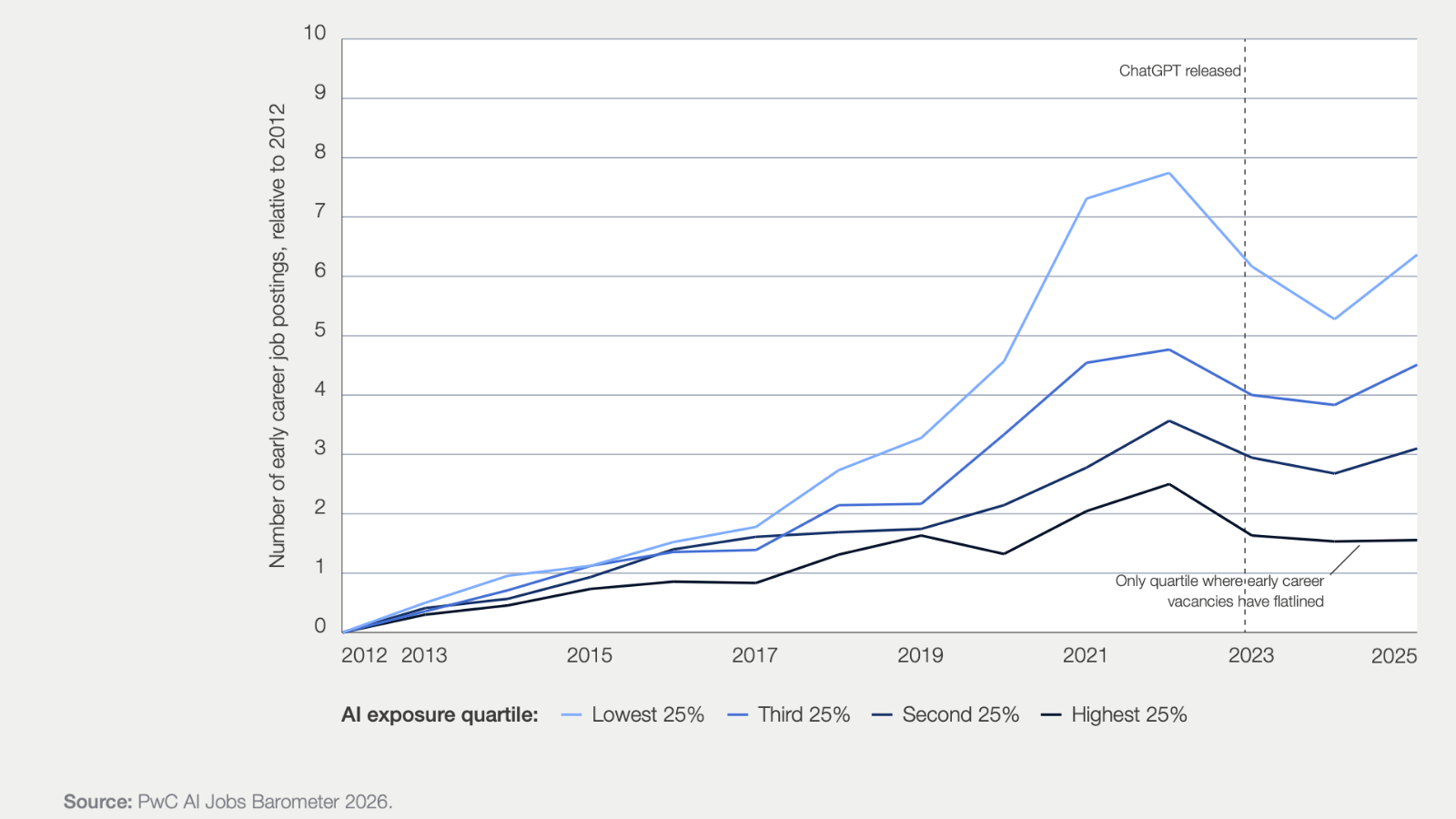
This PwC chart from the WEF report shows the number of early-career job postings relative to 2012, by degree of AI exposure. It’s difficult to conclude from the data that AI is causing a decline of entry-level roles. However, AI is reshaping roles and how work gets done by entry-level employees.
These mixed signals are why I keep coming back to a point of view we refer to as Durable Ownership (DO): A transition from being a consumer of content and tasks to a Co-creator of impact and outcomes that matter to people, business priorities, and our sustainable world. It is a commitment to actively growing personal and professional assets with an owner's way of life: your intellectual capital powered by well-being, your reputation for being invaluable and trusted, and your go-to community of other business domain experts.
Judgment is a differentiator
The WEF/PwC research backs this from the employer side. Business leaders aren't just asking who knows the AI tools, they're asking who can interpret outputs, question recommendations, and apply judgment for the moment. Demand is shifting toward human-centric skills like critical thinking, problem-solving, creativity with other people, and working alongside AI agents. Those are hardest to teach in a classroom, since curricula are often designed months or even years in advance while the current pace of AI reshapes how we work every week.
Formal education institutions need to be supplemented with peer-to-peer conversations and skills-based learning. One of our Founding 500 members and a transfer college student, heading to a University of California campus this fall, said it well in a recent discussion inside Creatorbase:
AI is something that needs to be continuously self-monitored, and there's a cap on its positive influence for every project. It's easy to go beyond the cap, resulting in something that looks and feels like it is AI-created. Self restraint is incredibly important, especially in creative projects. AI is great as a tool when it has a less obvious voice like fixing bugs or format alterations. But we need to be cautious about giving it a broad creative voice, in obvious ways like image generation and less obvious ways, like problem solving. Responsible AI usage is imperative to preserve the project's integrity. This understanding comes from intentional engagement with AI tools, and self-learning their capabilities — it’s a skill that we must teach ourselves through hands-on learning and co-creation with others.
Grow your Durable Ownership™
For younger people entering the workforce and their parents, the WEF research and a current college student’s instinct suggest three actions:
- Co-create applied experiences with intention. Seek weekly discussions with other experts; secure internships and challenging work projects that require you to make important discoveries and decisions, not just follow prompts.
- Practice self-restraint as a skill. Use AI for the less obvious “personal voice” work, and save your own judgment for creative and strategic decisions and actions.
- Manage your Durable Ownership assets. Intellectual capital, well-being behaviors, trustworthiness, your invaluable and trusted community of domain experts. These compound over time like a high-growth investment; AI fluency alone doesn't.
Parents, talk with your college kids about this now and on a regular basis; not after graduation. College students, share your “DOer” insights and “DOne” impact and outcomes with parents during regular visits or phone calls while away at school. Together, we'll connect, learn, create, and grow as life goes!
Help us help you and others
How are you co-creating the future in your business domain? Choose at least one action below to engage:
- Subscribe to the Creatorbase Brief weekly newsletter.
- Apply to join our community and media organization as a Founding 500 member.
- Participate on a Co-cre8 team to start your co-creation journey today.


